Wednesday, July 21, 2010

European Union welcomes new even lower roaming charges

As promised, as of yesterday the citizens of the 27 EU countries are paying less for calls and data while travelling across the European Union.This is the second step in the EU Parliament program for cutting the roaming charges, which started last year and will be completed next July when prices will be pushed down once again.

Calls and text messages

To refresh your memory, last April the European Parliament voted in favor of forcing network carriers in all EU countries to lower roaming prices under the set levels. And as of 1 July 2009 EU citizens travelling across the European Union should pay no more than 0.43 euro per minute for outgoing calls, 0.19 euro for incoming calls and 0.11 euro per sent SMS.

As of 1 July 2010 the maximum charge for outgoing calls drops to 0.39 euro per minute, while incoming calls shuldn't cost more than 0.15 euro per minute. Receiving voice mail messages should become free altogether.

The third and last price cut should kick in on July 2011. Then EU roaming charges will fall to 0.35 euro per minute of outgoing calls and 0.11 euro for incoming calls.

Data

Data charges underwent changes as well. On 1 July 2009 the wholesale price per megabyte was lowered to 1 euro. Yesterday it dropped to 0.80 euro per megabyte and on 1 July 2011 it will be cut to 0.50 euro per megabyte.

However, the data charge limits voted by the EU Parliament are actually the maximum price network carriers should charge each other, not the one they should charge customers. In other words, in this case the EU Parliament relies on the competition between operators to result in lowering data charges, rather than imposing a price cap.

Cut off limit per month

The last price cut concerning roaming charges is the 50 euro cut off limit per month, which should leave shockingly high phone bills in the past. Thanks to it a cut off mechanism is activated when the roaming charges reach 50 euro. Of course, if needed customers can set a higher (or even lower) cut off limit.

Keep in mind that all quoted prices exclude VAT where applicable and are for calls, messages and data within the European Union.

That is how a Summer should start. Now, if we could get a few sunny days instead of all the rain we have been seeing lately, it would be perfect.

More details on the Android 3.0 a.k.a. Gingerbread requirements

Gingerbread, the next level of the Android OS, will show up on time for the Christmas shopping but details on it have already started to surface one by one.

However, yesterday's rumors of Gingerbread's requirements are actually not completely true. Those are in fact recommended, not minimum.

The Android 3.0 Gingerbread was first said to require some quite powerful hardware to be built in the devices it is going to run on but today the same source, Eldar Murtazin (Mobile-review.com's editor in-chief), tweeted the following clarification:

"Yesterday have a very good conversation and some clarifications. 1 Ghz, 512 Mb etc its not minimal requirments but recommended one"

So, the new Android version will not lead to the platform splitting so all Android fans can now calm down. However, there is no word on the rest of the rumored details so we presume 3rd-party UIs won't be welcome anymore after all.

Along with smartphones, tablets should also be invited to the Gingerbread party since the Android v3.0 will feature support for a new 1280 x 760 pixel resolution and displays measuring 4 or more inches.

Apple finds iPhone 4 signal bars misleading, hiding poor signal

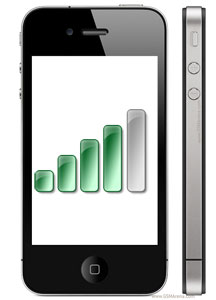
Apple just issued their official statement on the non-existent iPhone 4 reception issues. What iPhone 4 users are experiencing when they grip the lower left corner is just their real signal, poor as it seems. Their poor signal has so far been obscured by the deceptive signal bars, which obviously tend to exaggerate the signal levels due to some erroneous formula in the iPhone software.

Apple's statement on the iPhone 4 reception issues (which they previously dismissed as nonexistent), says that all phones have issues in areas of poor signal and it's just that the iPhones show the available signal in a wrong way. Apple plans to fix that with a software release that should make graphical representation of available signal more real. End of problem.

We've seen examples of Apple’s hypocrisy many times but this is just too much. To treat millions of customers who paid big money to have your latest product as a flock of sheep is just outrageous.

How on Earth could an erroneous signal indicator be the reason for dropped calls/reduced data rates? And what is that magical firmware that will bend the laws of physics and improve the iPhone 4 reception when you are holding it… you know… the way you've been holding every other phone you've owned so far?

Apple also dares take a hit at other phones (Motorola, Nokia and RIM) for losing some signal strength when held in a specific way. This is true, of course, but much like Apple’s statement that “iPhone 4 makes video calls a reality”, the implied by this one is ridiculous in much the same way. No other handset loses as much signal when held in a natural way, let alone drop calls because of this.

So yeah, thanks for the effort Apple, but no thanks.

For a good laugh you can follow the source link and read Apple’s full statement.

Yet another video of Symbian^3- based slider Nokia N9 appears

Yet another video of  Symbian^3- based slider Nokia N9 appears
While the name of the rumored Symbian^3-running Nokia slider (a.k.a. Nokia N9) is still a mystery, it's hardware and software are already pretty familiar to us. After all, the device appeared on numerous videos and images. And today we get to see the Nokia N9 (E7-00, N8-01, N8-02, you name it) acting in yet another video.

The last time we saw the upcoming Nokia slider was only a few days back. Then we found out that the smartphone will pack a 4-inch capacitive multi-touch display (and not a 3.5-inch one), however, there are no news brought to light by today's video (save for the proof of Nokia N9's full Flash support).

And while we don't mind meeting the little fella, it will apparently be this Nokia N9 prototype's last appearance in front of TechnoBuffalo's cam since the thing got "remotely wiped" (presumably by Nokia) some 5 minutes into the video.

QWERTY-enabled Android smartphone HTC Vision spotted

The QWERTY-fied HTC Vision has not been officially announced by the company yet but if you're too eager to get yourself one of those Android-powered smartphones you can do it straight away. The phone has just been spotted selling on a Croatian website.

The rumored HTC Vision first was mentioned on HTC's own website, but back then we could only imagine what it will look like. According to the phone's user agent profile, it packs a hardware QWERTY keyboard, a 480-by-800-pixel display and runs the Android OS.

HTC Vision HTC Vision
HTC Vision shot in the wild

The guy, who posted these images, say HTC Vision will munch Eclairs (a.k.a. Android OS v2.1) and will have a zippy 1GHz CPU and 1.2GB of memory on board. As for the upcoming slider's screen, it is said to measure 3.7 inches.

There is still no word on the Vision's official launch date and price. Speaking of prices, the unit on the images above is selling for 3800 Croatian kune (or about 660 US dollars).

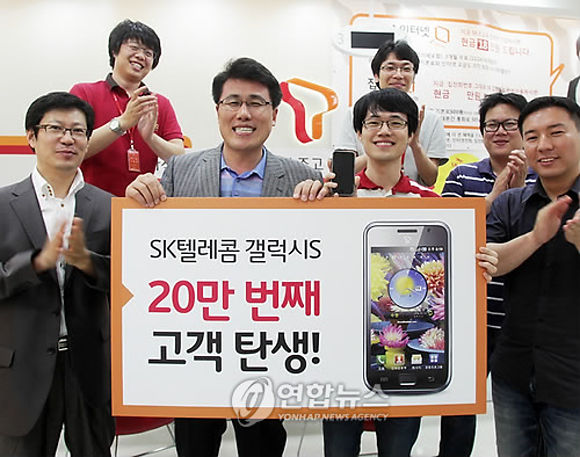
200,000 Samsung Glaxy S phones sold in South Korea in 10 days

The Samsung Galaxy S is selling very well - in South Korea. Samsung says it's because the Galaxy S is better tailored to the South Korean market than some of its competitors, like, say, the Apple iPhone 3GS.

The iPhone 3GS has sold 800,000 units in South Korea since its launch at the end of 2009. By comparison, the Samsung Galaxy S sold some 200,000 units in South Korea in just 10 days since its launch on June 24.


Samsung attributes this to the preloaded app package that serves South Koreans better than what the Apple offering comes with. Of course, this is quite a local view on things. (Worldwide iPhone 4 sales are ludicrous), but Samsung has a staggering amount of Galaxy S phones around the world too - "Galaxy S" has turned into a series rather than a single phone.

Anyway, congratulations to Samsung for a job well done - now, get those programmers back to work, we're waiting for the promised Android 2.2 Froyo update.

LG announces Optimus One and Chic, Froyo upgrades on the way

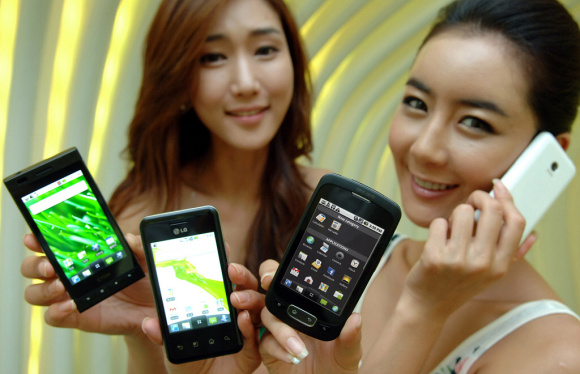
LG will expand their Optimus range with two entry-level smartphones - Optimus One and Optimus Chic. They will both run on the latest Android OS v2.2 Froyo, while the current Optimus Q and Z will be granted Froyo upgrades in the coming months.

LG also promises up to 10 new handsets under their Optimus Android series until the end of the year. That's some good news, since they've been to a rather slow start with smartphones this year.

The press release announcing the existence of Optimus Chic and One (which we couldn't stop calling Prime) brings almost no information about their specs. Both devices will be touch-based candybars running on Android v2.2 Froyo. They will most probably have Wi-Fi connectivity and some entry-level snappers and that's all we know so far.


LG Optimus One • LG Optimus Chic

LG also promises Android Froyo upgrades for their current crop of high-end Android smartphones - Optimus Q and Optimus Z. Unfortunately there is no word on an upcoming update for the original Optimus yet.


LG Optimus Z • LG Optimus Chic • LG Optimus One

Finally, in their brief press release, LG mentions their Windows Phone 7 device. It is in the works and will be released sometime this year. Thank you for the update LG, it answered plenty of questions, didn't it?